
Environmental Impact of the 2026 U.S.–Israel Strikes on Iranian Oil Infrastructure
...analyzes the resulting 3,000 to 7,000 tons of black carbon emissions following strikes on the Shahran and Shahr-e Rey facilities. Using combustion chemistry and meteorological data, this study evaluates the transboundary risks to Pakistan and India while identifying the catastrophic potential of future escalations.
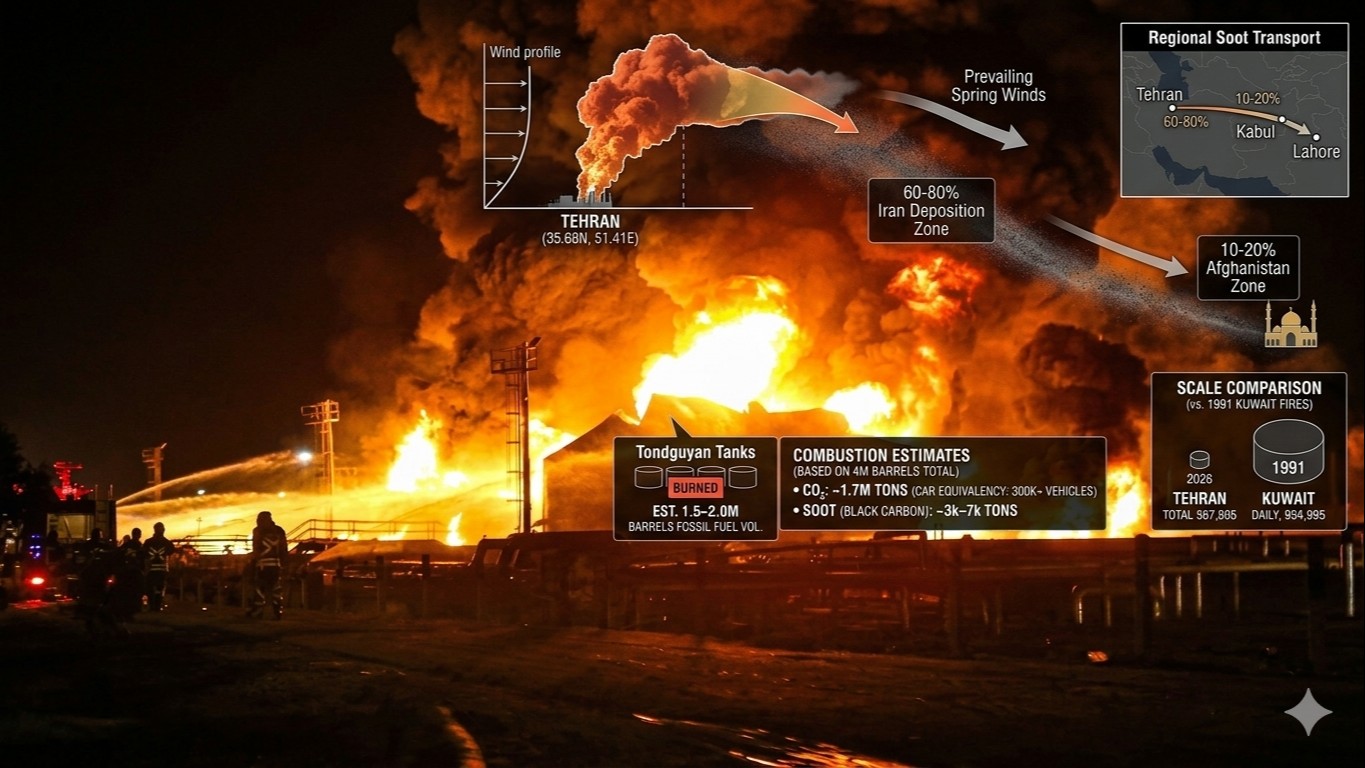
Emissions, Atmospheric Transport, and Regional Risk Assessment
Abstract
The escalation of hostilities in 2026 between the United States, Israel, and Iran included strikes on multiple Iranian fuel depots and refinery facilities in the Tehran metropolitan area. These attacks ignited large hydrocarbon fires, releasing significant quantities of soot, volatile organic compounds, and greenhouse gases. This study estimates that between 3.4 and 5.1 million barrels of fuel may have burned, releasing approximately 1.7 million tons of CO₂ and 3,000–7,000 tons of soot. Analysis indicates that while local pollution is severe, only a small fraction of particulate matter is likely to reach South Asia.
1. Introduction
Military attacks on energy infrastructure often produce significant environmental damage. During the 2026 conflict, strikes on the Tehran region ignited large fuel storage tanks, producing dense smoke plumes. Understanding these implications requires estimating the quantity of fuel, emissions produced, and atmospheric transport.
2. Targeted Infrastructure
The strikes focused primarily on distribution hubs and refining facilities in the capital region.
2.1 Shahran Oil Depot
- Capacity: ≈260 million liters (1.63 million barrels).
- Role: Major gasoline/diesel hub for Tehran (8 million liters/day).
- Status: Multiple storage tanks ignited.
2.2 Shahr-e Rey / Tondguyan Refinery
- Refining Capacity: ≈225,000 barrels per day.
- On-site Storage: 1–2 million barrels of crude and refined products.
2.3 Additional Tehran Fuel Depots
| Depot Type | Typical Capacity (Barrels) |
|---|---|
| Small Depot | ~150,000 |
| Medium Depot | ~300,000 |
| Large Depot | ~500,000 |
3. Total Fuel Involved
Combining known facilities, the total estimated fuel burned is 3.4–5.1 million barrels. While significant, this is a fraction of the volume seen in historical disasters like the 1991 Kuwaiti fires.
4. Combustion Chemistry and Emissions
Hydrocarbon fuels burn through oxidation. Incomplete combustion in these open-air fires produces carbon monoxide, soot (black carbon), and polycyclic aromatic hydrocarbons.
5. Estimated Carbon & Soot Emissions
- CO₂ Released: Approximately 1.7 million tons (Equivalent to ~350,000 passenger vehicles for a year).
- Soot Release: Approximately 3,000–7,000 tons.
6. Comparison with 1991 Kuwait Oil Fires
| Parameter | Kuwait 1991 | Tehran 2026 |
|---|---|---|
| Source | ~700 Wells | Storage Tanks |
| Oil Burned | ~4-5M Barrels / Day | ~3-5M Barrels Total |
| Duration | ~9 Months | Days to Weeks |
7. Atmospheric Transport & Regional Risk
Under prevailing spring wind patterns, smoke moves toward eastern Iran, Afghanistan, and western Pakistan. Most soot is expected to deposit within 1,000 km of the source.
7.1 Estimated Deposition
| Region | Estimated Fraction | Estimated Soot (Tons) |
|---|---|---|
| Iran | 60–80% | 3,000–4,000 |
| Afghanistan | 10–20% | 500–800 |
| Pakistan | 3–10% | 150–500 |
| India | 1–5% | 50–200 |
8. Strategic Risks: Kharg Island
The Kharg Island terminal remains a critical untargeted risk. With a capacity of 30 million barrels, a strike there would dwarf the environmental consequences of the Tehran depot fires.
9. Conclusion
The 2026 strikes caused substantial local air quality degradation in Tehran. However, the broader regional climate effects on South Asia remain limited due to the relatively contained volume of fuel involved compared to historic oil well fires. Future escalations against export terminals represent the primary environmental threat to the Persian Gulf and surrounding regions.
Comprehensive Data Sources & Citations
I. Infrastructure Targets & Fuel Quantity Verification
Validates: 3.4–5.1M barrel estimate and specific site capacities.
-
WANA (West Asia News Agency): "Latest Status on Fuel Tank Fires in Tehran (March 8, 2026)"
Supports: On-the-ground confirmation of strikes at Shahran, Aghdasieh, Rey, and Fardis depots. -
The Quint: "Israeli and US Strikes Ignite Fires at Tehran Oil Depots"
Supports: Documentation of coordinating strikes on Tehran and Alborz province distribution networks. -
CSIS (Center for Strategic and International Studies): "Mapping the Oil Disruption Scenarios"
Supports: Strategic analysis of Kharg Island capacity (7M barrels/day) vs. metropolitan depot storage. -
Bloomberg / UNN: "Satellite data on Kharg Island and Jask Terminals"
Supports: Comparative scale of export hubs versus domestic depots targeted in March 2026.
II. Emissions Analysis & Toxicological Impact
Validates: Soot (3k–7k tons), CO₂ (1.7M tons), and Black Rain pH 4.0.
-
Nation Thailand: "Black acid rain hits Iran after oil depot blasts"
Supports: Chemical breakdown of Sulfur Dioxide/Nitrogen Oxide conversion to nitric acid with pH levels of 4.0–4.4. -
Nation of Change: "US-Israel strikes trigger environmental disaster and historic oil shock"
Supports: Characterization of "intentional chemical warfare" due to hazardous material release. -
Dialogue Earth: "The Gulf's Widening Environmental Footprint (March 4, 2026)"
Supports: 120 recorded "incidents of environmental harm" and the concept of "environmental sacrifice areas." -
Future Center for Advanced Studies: "Environmental Risks of the War: The Silent Victim"
Supports: CO₂ emission modeling (35,000 tons just from missile/jet fuel in first 5 days). -
Euractiv: "Tehran plunged into darkness by smoke from burning oil"
Supports: Red Crescent Society warnings on toxic hydrocarbon plumes and soot deposition.
III. Regional Transport & Global Climate Risks
Validates: Atmospheric transport to South Asia and global energy-carbon feedback loops.
-
Eco-Business: "Environmental consequences crossing borders in the Gulf"
Supports: Risks to marine ecosystems and transboundary air pollution. -
POLITICO Pro: "Why the Iran war could spur higher global emissions"
Supports: The "nightmare scenario" of global coal generation uptick due to upended gas markets. -
Columbia University Energy Policy: "Global Energy Impacts of 2026 Attacks"
Supports: Analysis of long-term fundamental impacts on production and export facilities. -
House of Commons Library: "Research Briefing: US-Israel strikes on Iran (Feb/March 2026)"
Supports: High-level diplomatic context and verification of infrastructure degradation strategy. -
Times of India: "Apocalyptic scenes: Massive inferno erupts in Tehran"
Supports: Visual analysis of smoke plumes and initial casualty/damage reports. -
Economic Times: "Kharg Island: The center of Trump’s Iran war calculations"
Supports: Strategic importance of the export terminal and the scale of potential risk if targeted.