
The AI-Climate Paradox: From Carbon Debt to Planetary Intelligence
In the race for artificial intelligence, we have reached a startling crossroads: every digital breakthrough is now met with a physical cost. From the '500ml rule' of water consumption to the emergence of data centers as urban heat batteries, we explore why efficiency alone won’t save the planet. It is time to move beyond measuring AI by its IQ and start auditing its planetary footprint.
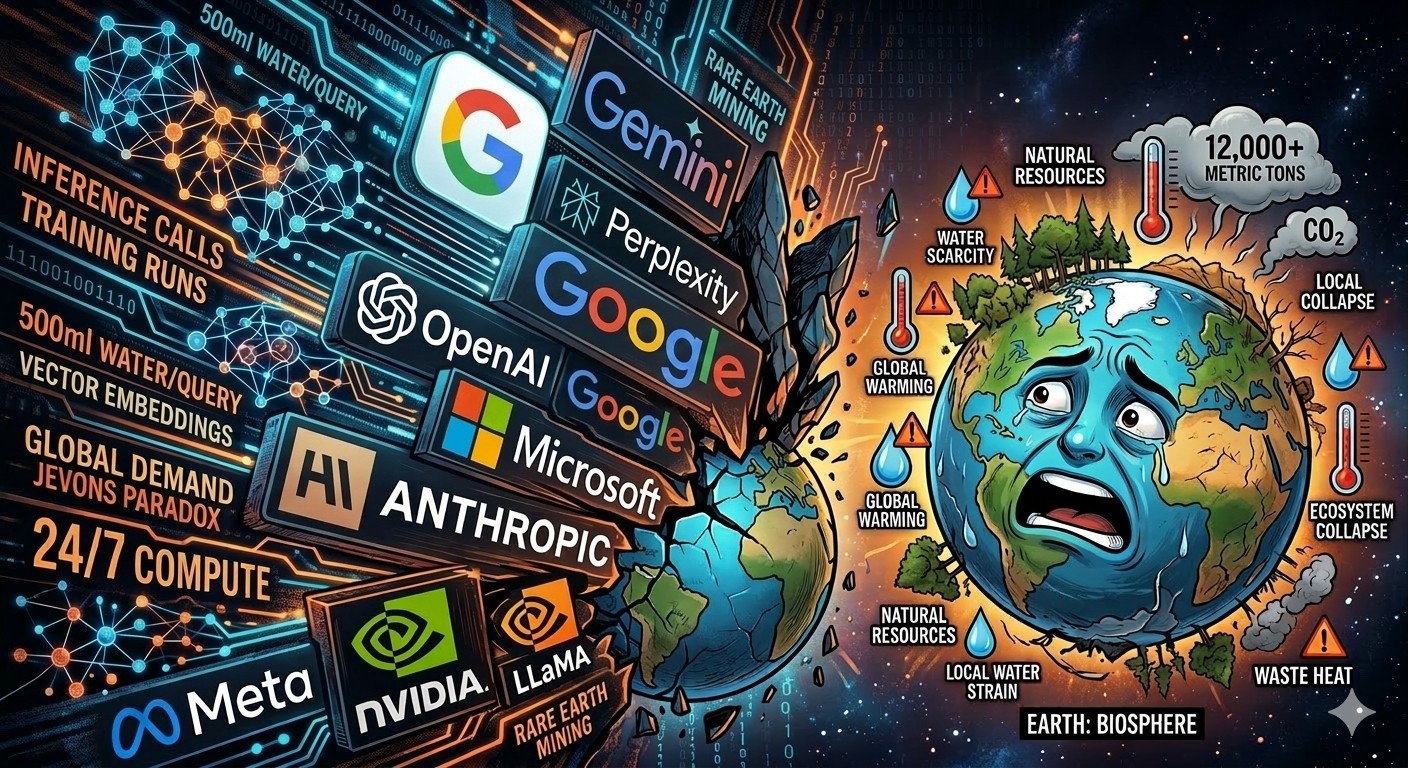
As we move through 2026, the narrative surrounding Artificial Intelligence has shifted. We are no longer merely asking how smart a model is, but how "heavy" it is. While AI offers the potential to solve complex climate modeling and optimize renewable energy grids, it carries a hidden environmental price tag that is becoming impossible to ignore. To build a sustainable digital future, we must look beyond carbon footprints and address the systemic paradoxes of the AI era.
The Efficiency Trap: Understanding the Jevons Paradox
In the early 2020s, the tech industry focused almost exclusively on making AI models more efficient. By 2026, we have achieved massive breakthroughs; a single query today uses roughly 90% less energy than it did three years ago. However, this has led to the "Jevons Paradox." As AI becomes cheaper and more efficient, its integration into every facet of our lives—from smart appliances to automated emails—has caused aggregate energy demand to skyrocket. Efficiency hasn't lowered our impact; it has simply expanded our appetite for compute.
The 500ml Rule: Visualizing Digital Thirst
Water has emerged as the most critical KPI in the 2026 sustainability landscape. Every time a user engages in a standard 25-prompt session with a Large Language Model, the system effectively "drinks" 500ml of water. This water is used for cooling the high-performance GPU clusters that power the inference. Unlike carbon emissions, which impact the global atmosphere, water consumption is a hyper-local crisis. Data centers are increasingly competing with local agriculture and municipal supplies, making "Water Usage Effectiveness" (WUE) a mandatory metric for ethical AI development.
From "The Cloud" to Urban Heat Batteries
One of the most innovative shifts in modern infrastructure is the rebranding of data centers. No longer viewed as isolated warehouses, 2026-era data centers are being designed as "Urban Heat Batteries." In cities like Frankfurt and Stockholm, these facilities are legally integrated into district heating networks. The "waste" heat generated by processing your AI requests is captured and piped directly into local schools and homes. This "circular thermal economy" ensures that every watt of electricity used for intelligence is used a second time for survival.
Cognitive Sovereignty and Agentic Rewilding
The future of environmental AI is moving toward "Sovereign Ecological AI." This involves moving away from massive, centralized models toward Small Language Models (SLMs) owned by local communities. In the Global South, indigenous groups are using these models to monitor biodiversity and illegal deforestation in real-time. Simultaneously, "Agentic Rewilding" systems are deploying AI-powered drone swarms that analyze soil chemistry and pollinator health to autonomously replant ecosystems with surgical precision. AI is transitioning from a tool that merely predicts environmental collapse to an agent that actively prevents it.
Conclusion: The Metric of "Intelligence-per-Drop"
The standard for tech leadership in 2026 is no longer about who has the largest parameters or the fastest response time. Success is now measured by "Intelligence-per-Drop"—the amount of actionable insight a model can generate per liter of water and gram of carbon. For the environmental movement, the goal is clear: we must ensure that the intelligence we create today does not cost us the Earth tomorrow.
Scientific & Regulatory References
I. The Jevons Paradox & "Rebound" Emissions
- CIGI (2026): The AI Energy Paradox: Why Efficiency Isn't Conservation
- Sopra Steria (2025): AI and the Jevons Paradox: Why Efficiency Can Backfire
- Babson Germany (2026): The Low-Cost Trigger: How DeepSeek & Open Models Accelerate Demand
II. Global Water Scarcity & The "500ml Rule"
- GOV.UK Report (2025): Water Use in AI and Data Centres: Executive Summary
- Mordor Intelligence (2026): Data Center Water Consumption Market Growth & 2031 Projections
- EESI (2024): The Indirect Thirst: Power Grid Water Use for AI Computations
III. Waste Heat Recovery & Urban Integration
- World Economic Forum (2025): Turning Energy Guzzlers into Community Heaters: Stockholm & Finland Models
- Bloomberg (2025): Finland's Model: Data Center Waste as Municipal Utility
- Aquatherm (2025): Technical Analysis: 40% Energy Recovery Rates in Modern Liquid-Cooled Pods
IV. Sovereign AI & Indigenous Stewardship
- Mila AI Institute (2025/2026): Indigenous Pathfinders: AI for Buffalo Restoration & Wildfire Mitigation
- Brookings Institution (2026): Digital Sovereignty for Tribal Nations in the AI Age
- Oxford Insights: Indigenous-Led AI: Combining Traditional Wisdom with Earth-Friendly AI
V. Regulatory Deadlines & Training vs. Inference
- European Commission (2026 Update): Navigating the AI Act: The August 2026 High-Risk Implementation Deadline
- arXiv:2507.11417 (2025): Quantifying Energy Consumption of LLM Inference vs. Training
- White & Case LLP (2025): Compliance Obligations for General-Purpose AI Models (GPAI)